Mouvement pour l'Égalité entre les Femmes et les Hommes



Improve police, medical, and social service responses to and follow-up on domestic violence
The first responders to domestic violence situations are often the police. The latter, as « coordinators » of support services for victims and aggressors, must collaborate with other service providers. However, in many European jurisdictions, various individual, organizational and systemic barriers hinder their ability to make necessary referrals.
A lack of specialized training and skills among police officers to adopt a victim-centered approach is often noted. At the organizational level, the lack of clear rules for the behavior of police officers in cases of domestic violence creates difficulties. From a systemic perspective, barriers arise when public and community organizations fail to collaborate effectively.

Goals
The TACTICS project will build on previous work to strengthen the police and community response to domestic violence. This improvement will take place at the level of local courts in seven countries where TACTICS will be deployed (Estonia, Bulgaria, France, Germany, Greece, Spain, Romania).
Our team will work with the police, victim support services and perpetrators to improve their responsiveness to domestic violence. This will involve capacity building activities and multi-agency cooperation. It is crucial to increase awareness and adopt an appropriate attitude towards victims of domestic violence, especially those with specific needs such as the elderly, drug addicts, refugees etc.
We will also develop innovative digital solutions to address gaps in community responses to domestic violence.
TACTICS will form working groups in each region to overcome obstacles to structural change. The aim is to define systematic responses to domestic violence, including the creation of regional roadmaps to guide current and future improvements in collaboration between agencies, formalizing cooperation, improving the assessment of risks and other police procedures related to DV.
The results will be widely disseminated among partner countries and at European Union level.
Results
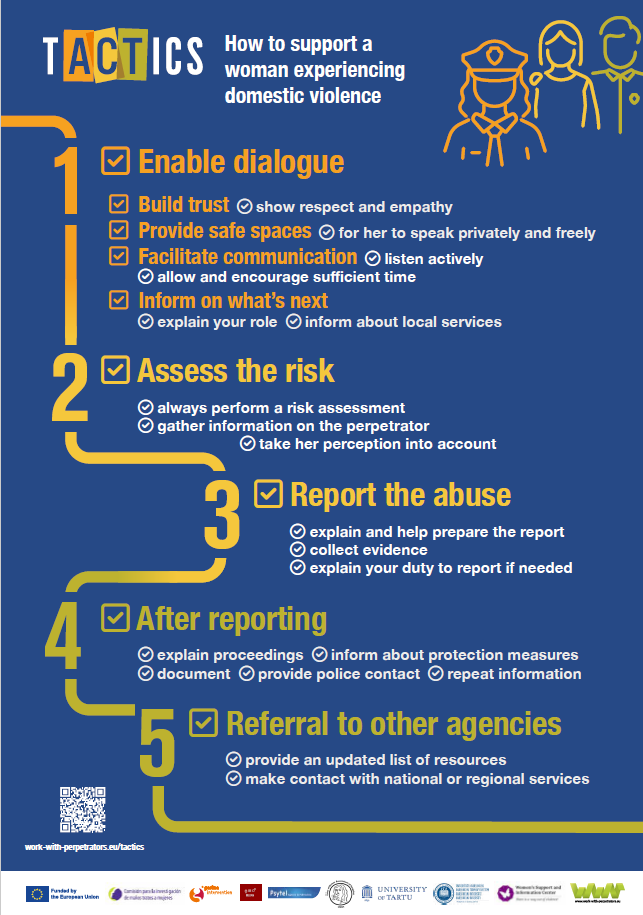
A checklist has been developed to ensure that women who are victims of intimate partner violence receive the appropriate support. This tool covers everything from the initial conversation with the victim to referrals to other services, including risk assessment, reporting the abuse, and follow-up after reporting. It allows professionals to quickly verify that all necessary steps have been taken or to make corrections if needed. The checklist is available as a brochure and a poster.

During the project, training modules were developed, tested, and approved. There are seven modules in total: introduction, enforcement, risk assessment, multi-agency collaboration, working with female victims, working with perpetrators of domestic violence, and data solutions.
These modules are available online at: https://fr.dvknowledge.eu/
A roadmap was also developed during the project. It provides an overview of the mechanisms for responding to domestic violence in Belgium. It then identifies the obstacles to multi-agency collaboration in this area. Finally, it offers recommendations for improving the support mechanisms and multi-agency collaboration in the management of domestic violence cases.